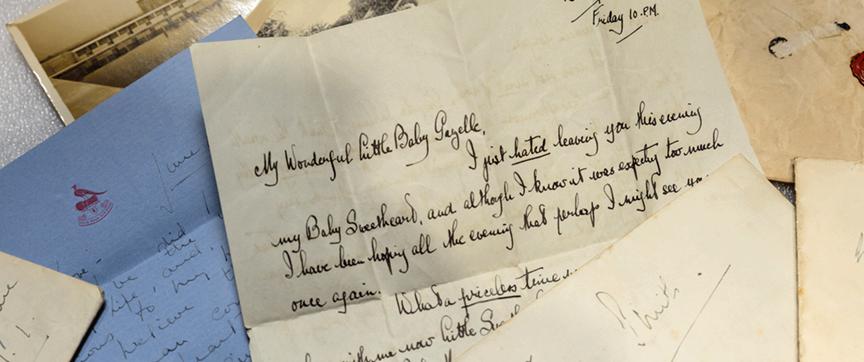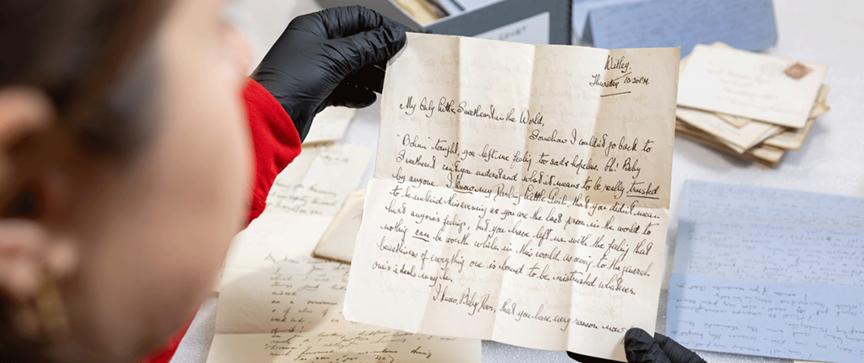


A collection of love letters have been uncovered.
Lost love letters have offered a rare and intimate glimpse into a long‑hidden romance at Witley Court, after English Heritage uncovered a remarkable collection of early 20th‑century correspondence.
The letters were exchanged between Dora Smith, daughter of Sir Herbert Smith, the final private owner of Witley Court, and Noel Murray “Fred” Pearson. Their discovery is as unexpected as it is evocative: the bundle was found in the 1960s tucked inside a shoebox in the archives of a local accountancy firm, where they were carefully preserved for decades by employee Elizabeth Jones.
Together, the letters form a vivid portrait of a young couple whose affection grew despite difficult circumstances. Dora and Noel first met while Dora was still married to her first husband, and their early exchanges reveal a relationship that was both tender and illicit.
Over the years, their correspondence charts the evolution of their bond, from playful notes filled with private jokes to heartfelt declarations that hint at the emotional turmoil of loving someone they could not openly be with. Their story ultimately found resolution following Dora’s turbulent divorce, the pair married in 1929.
Matty Cambridge, Assistant Curator at English Heritage, described the discovery as particularly moving. “These letters are so warm and funny, but what is really touching is the timespan they cover,” she explained. “They run over a number of years, including a period when Dora was living at Witley Court and married to her first husband. We know Dora and Noel eventually tied the knot in 1929, but not much else. If anyone knows more about what their story looked like, we’d love to hear from you.”
The letters also reveal the couple’s playful side. Affectionate nicknames such as “Snuffy Scruffy” and “Little Baby Gazelle” appear throughout, offering glimpses of their shared humour and the private language of their courtship.
English Heritage’s curatorial team is now reviewing the collection to assess its historical significance and determine the best approach to conservation, ensuring this poignant chapter of Witley Court’s past is preserved for future generations.
Photographs: English Heritage