

New life by recycling old barges
An engineering feat is taking shape in the Blackwater Estuary, Essex where the National Trust has sunk three decommissioned Thames lighters to form a new island designed to help protect some of the UK’s most threatened seabirds. The Blackwater Estuary is home to around 10% of the UK’s population of Brent geese.
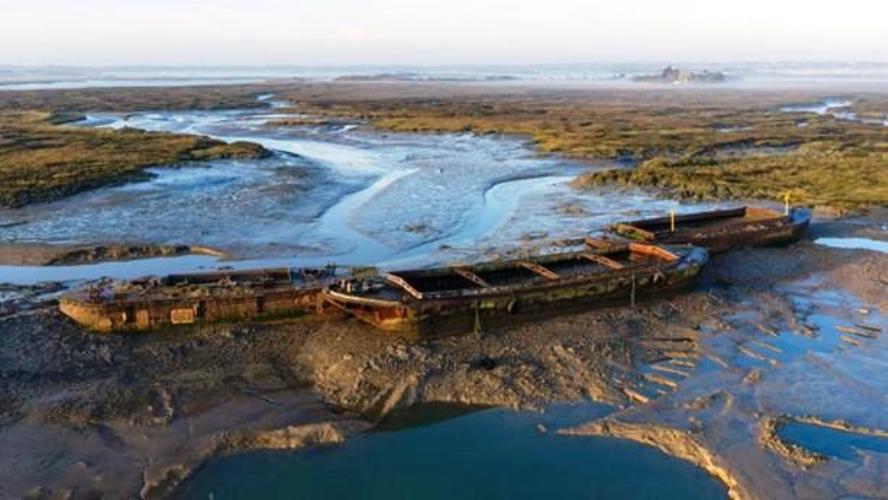
Thames Lighters are a traditional, flat-bottomed, unpowered barge. Historically used for transporting goods between large ships and wharfs on the River Thames in London. Named because they "lightened" ships' cargo, these iron or steel vessels were essential for moving coal, grain, and timber, typically towed by tugs. The retired lighters have spent more than 30 years moored in Essex. Measuring between 20 and 32 metres long, they now sit on the inter tidal mudflats of the estuary creating a new land mass on the edge of the saltmarsh at Northey Island as part of conservation efforts.
The project marks the latest chapter in more than 30 years of cutting edge coastal adaptation work in the estuary where the conservation charity has been trialling innovative, nature based solutions to protect Northey Island against rising sea levels and the rapid loss of saltmarsh.
The boats have been decommissioned for some time, so work was needed by specialist contractors to make them clean and seaworthy again before they could be towed into place and set onto a platform of sediment. Holes were cut into the hulls to sink the vessels and they were then filled with sediment, mostly mud, to weigh them down to secure them. Once the island is fully established with gravel on top, it will sit safely above the highest tides to offer a safe refuge for some of our bird species which are in decline.
Up to 8,000m³ of sediment, roughly the volume of more than three Olympic swimming pools, is being used to fill and surround the barges before the final gravel surface is added.
Once the work is complete, the island will add 0.55 hectares (1.4 acres) of vital new habitat, almost the size of a football pitch, within the Blackwater Estuary, one of the most ecologically important wetland systems in the UK.
National Trust will be continuing to top the island with sediment for a little while and then wait to see when the birds will start to use their new sanctuary.
By sheltering the marsh from wave energy, the new island will also help to slow erosion and protect this precious habitat.
Northey Island is open to the public from April to September and closed in winter to protect overwintering birds.
More information can be found at www.nationaltrust.org.uk/northey-island
Photograph: National Trust