
Conquest Man story revealed
The skeleton known as Conquest Man was discovered in 1980 during archaeological excavations at St Peter's Church in Barton-upon-Humber, Lincolnshire. New research into the 1,000 year old skeleton has unveiled more information about the remains. The discovery has also shed a new light for experts and their understanding of the period.
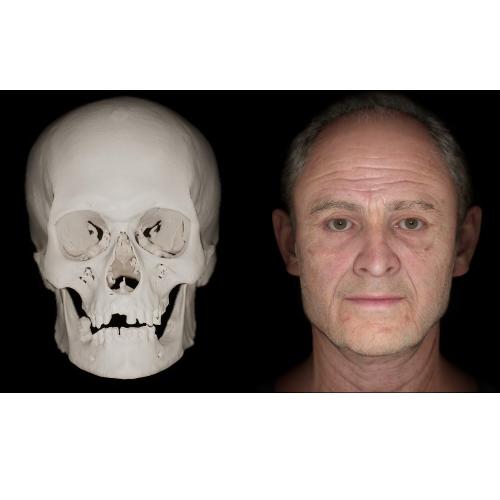
The research process involved a series of tests on his skeleton. Osteological analysis, Ancient DNA, Isotope analysis, a digital facial reconstruction, which for the first time brings us face to face with an person who lived through the Norman Conquest.
Here is what they have discovered:
Conquest man was a stocky and muscular man just over five foot tall, around 50 to 60 years old and with evidence of multiple healed fractures.
His DNA suggests substantial ancestry from continental Europe. The oxygen levels in one of his teeth are consistent with time spent in a cold climate as an adolescent, while the strontium levels are more compatible with the area closer to Barton on Humber. He was born in the reign of Viking King Cnut, he survived the Norman Conquest.
He was given a privileged burial in the private church of one of William the Conqueror’s knights, at St Peter’s in Barton on Humber. He was laid to rest in a coffin made from an oak tree felled in c.1079. His arms were folded and his head was on a grass pillow supported by two lumps of local chalk to keep it from falling sideways. Three apple wood staffs, grave goods in the Scandinavian tradition, were by his side.
What the research also shows is that it is not known if he was Saxon, Norman or even just a traveller. By the 11th century England was an Anglo-Scandinavian nation and there was a strong Scandinavian influence in Normandy. Anglo, Scandinavian and Norman interests were closely connected.
The science does not point to one simple homeland for Conquest Man. Instead, his skeleton, burial, ancient DNA and isotope results suggest a man connected to the wider continental world. He may have travelled to Barton, or he may have been born locally into a community already shaped by those connections.
In either case, his burial suggests that the traditions associated with him were meaningful and recognisable within the Barton community, reminding us that identity in 11th-century England was far more complex than simple categories like Saxon or Norman.
To get a sense of what life was like for Conquest Man during the Norman Conquest, Battle Abbey in East Sussex is hosting its annual reenactment of the Battle of Hastings on 10 and 11 October 2026.
Tickets are available from:
www.english-heritage.org.uk/battle
Photograph: English Heritage