

Health Article
- Nail Clipping
Most, if not all, dogs, cats and rabbits nails need trimming.
The frequency will depend on how fast the nails grow to long and if the animals are keeping their nails trimmed themselves naturally.
Animals that walk, run or climb on and over hard surfaces can keep their nails shorter, but it is always better for your humans to keep an eye on them too, as long nails can be painful and could cause other long term problems.
The nails:
Now before your human starts clipping away at your nails, they need to know a few essential things about the anatomy of the nails.
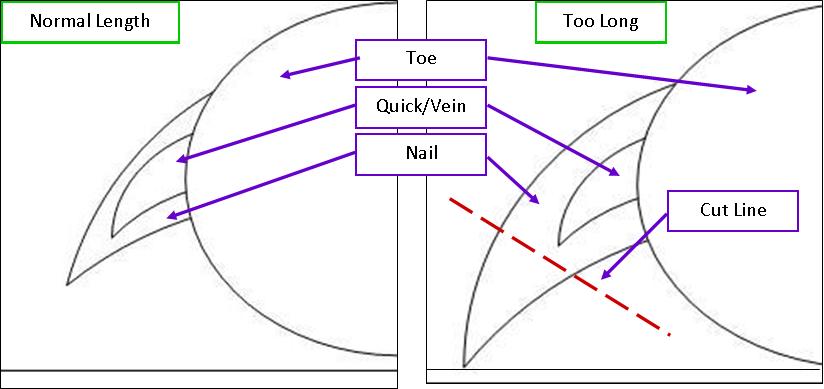
Each nail has a vein running down the inside of it. These veins are in their nails because their claws are living extensions of their toes. This sensitive vein is called the "quick". It contains essential blood vessels that deliver vital nutrients and oxygen for healthy nail growth, as well as dense nerve endings that provide sensation.
Problems to avoid:
When an animal’s nails grow too long, they alter how the paw works. In a healthy paw, the animal’s weight is distributed evenly across their paw pads. Long nails force the toes upward, shifting the animal's weight backward onto the hind feet. This places stress on the joints which will probably immediately cause discomfort and pain and could lead to tendon strain, spinal misalignment, split nails, infection and even early arthritis.
Regular checking:
Normally it would be a good idea to check the nails every 3 to 4 weeks, which would be enough for nails that are at an ideal length. It is also good to check for any breaks or splitting of the nails.
If an animal is walking on the floor and your human can hear a clicking of the nails, then that is usually a sign that the nails are too long and will need some trimming.
Older or sick animals that are not as active will probably need their nails checked much more frequently.
Regardless to weather your human takes you to a groomer or vet to get your nails trimmed, the first thing they should do is to start a regular process where they touch your paws. Too many groomers and vets have to spend ages getting an animal calmed down enough to get their nails trimmed. This can easily be avoided by getting animals used to humans touching their paws.
Your humans should frequently touch your paws and even touch each toe so that you no longer get stressed. If you snuggle up to your human daily, they should sit and play with your paws.
In fact getting you used to being touched by your human on the paws, legs body, ears and mouth is not only a good idea, it can sometimes be life saving if there is an emergency and you need to be handled. As there may be no time to go gentle to avoid stressing you out.
Maintenance:
An animal’s nail consists of a hard outer shell made of keratin and a sensitive inner core known as the "quick." The quick contains blood vessels and nerve endings.
For a successful and stress free nail trim, Your human or professional should use the correct tools and be aware of how and where to trim the nails. There are a variety of tools to use such as clipper, grinders or even nail files.
Choose a quiet, well-lit room with non-slip flooring to prevent anxiety and slipping.
Basic guide to nail trimming:
Secure the Paw:
Hold the paw firmly but gently.
Separate the toes by placing your thumb on the top of the toe pad and your index finger underneath.
Identify the Cut Line:
This can be tricky to find. On white nails the quick is visible as a pink interior shadow. On black and darker nails it is not always possible to see.
Angle the cut:
Cut at a 45-degree angle, mimicking the natural slope of the nail toward the floor, ensuring the quick is avoided.
Cutting:
Make small trims at the end of the nail, working towards the quick each time, but without hitting it.
Even with white nails check the area of the nail that has just been trimmed every time. When a small dark grey or black dot starting to appear, stop trimming that nail as it is getting near to the quick.
Repeat the process for each nail. Don’t forget the dew claws, which are located higher up the leg from the toenails. Sometimes focusing on cutting the nails on the paws, the dew claws get missed.
Other advice:
Sometimes an animal ends up with overgrown nails. These cannot be trimmed back to the correct length in one go as the quick will have grown along with the nail. To get the nail back to the correct length, carefully trim as far as you can. Then try again in a few days as the quick will have started to shrink back. This process can take several regular sessions until the nails are at the correct length.
Consistent maintenance keeps the quick short, making future trims easier and safer.
If the quick gets cut during a trim don’t panic as it will cause the animal to panic and make the next trimming session so much harder to do.
There can be a lot of blood, but medical help is not necessarily required, unless the animal is ill or on medication that may prevent natural blood clotting. You can use Styptic Powder or corn flower to help stop the bleeding.
Below are (very) basic drawings to give an idea of a normal length nail and a nail that is too long.
The only exception to the above, is that cats can retract their nails, so extra inspection of the nails is needed to check their actual length.