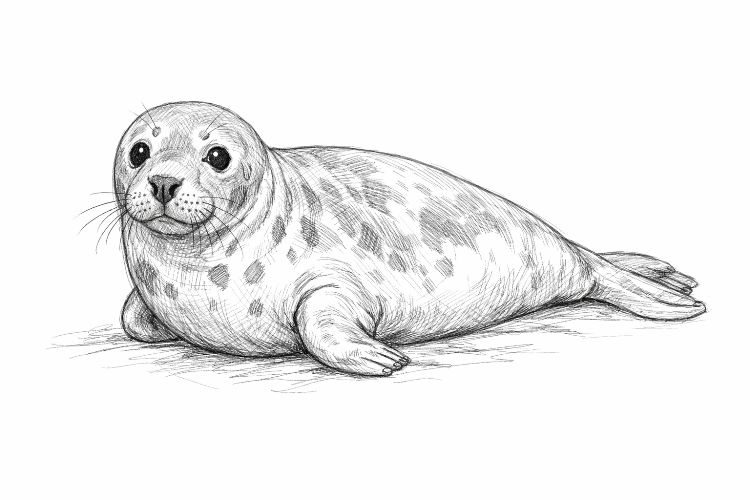


History of... Grey Seal
Name:
Grey Seal
Scientific Name:
Halichoerus grypus.
Family:
Phocidae.
Conservation Status:
Least Concern.
Habitation:
The waters of the North Atlantic Ocean. They can be spotted on remote rocky shores, sandy beaches, sandbanks, sea caves, and ice floes
There are three distinct geographical populations:
The Western Atlantic:
From Labrador, Canada, down to New England in the USA.
The Eastern Atlantic:
Concentrated around the British Isles (40% of global population), Iceland, Norway, and France.
The Baltic Sea:
A isolated population native to the enclosed Baltic region.
Discovery:
Fossil records and historical documentation shows that seals had existed for thousands of years prior to scientific naming.
The grey seal was first formally classified by the Danish naturalist Otto Fabricius in 1791, who described a specimen from the Baltic Sea.
Description:
With a long bulky streamlined body for swimming and a long sloping convex nose and a thick neck. Females have a flatter, narrower profile. Males reach 2.5 to 3 metres in length and weigh 230 to 400 kg. Females 1.8 to 2.2 metres and weigh 150 to 200 kg.
Females typically have a silver grey or brown coat with dark, scattered spots. Males feature a dark grey, charcoal, or dark brown coat with lighter spots.
Behaviour and Social Structure:
Seals are highly social on land but mostly solitary when at sea. On land they live in large groups called rookeries or colonies.
They look clumsy while moving on land but don’t be fooled, they can still move faster than a human.
In the water they are incredibly fast agile, propelled by their powerful rear flippers.
Diet and Feeding Habits:
Seals usually feed at depths of 30 to 70 metres, but they are capable of diving to depths over 300 metres and can remaining under water for up to 20 minutes.
Their diet consists primarily of fish, sand eels, squid, octopus, crabs and lobsters.
Breeding:
Breeding takes place between August and January, depending on the geographical location.
Females give birth to a single pup weighing around 14 kg and nurses the pup for 16 to 21 days on milk that is around 50% fat. The female does not eat during this time and can lose up to a quarter of her body weight.
Once the pup is weaned and has shed its fluffy protective white lanugo coat which is not waterproof, the mother leaves for the sea.
Threats to Population:
Natural predators such as killer whales and sharks.
Getting caught in commercial nets or discarded ghost fishing gear, leading to drowning or injury.
Human Disturbance from tourism, boat strikes, and beachgoers approaching too close can cause mothers to abandon their unweaned pups.
Pollution from actual rubbish in the sea and chemical pollution.